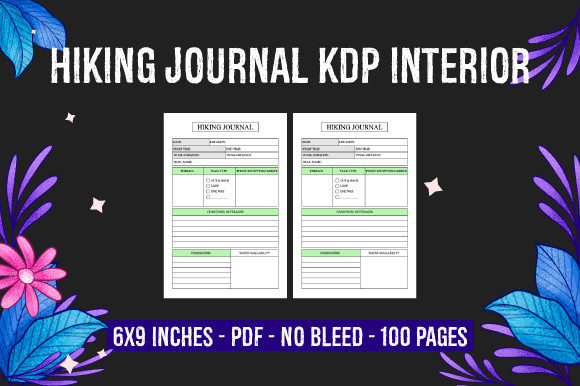
Hiking Journal KDP Interior: Ready-to-Use PDF Files
Creating a successful low-content book on Amazon Kindle Direct Publishing often comes down to the quality and utility of the interior. For publishers targeting the outdoor niche, a generic lined notebook rarely satisfies the specific needs of hikers and trail enthusiasts. A specialized Hiking Journal KDP Interior bridges this gap by providing structured, relevant prompts that transform a simple notebook into an essential piece of gear. This ready-to-use digital asset eliminates the most time-consuming phase of self-publishing: interior design and formatting. By utilizing a pre-formatted 100-page PDF, creators can bypass technical hurdles and focus entirely on cover design, keyword research, and marketing strategy.
The value of this specific interior lies in its immediate applicability. It is not merely a template but a finished product file designed for the 6″ x 9″ trim size, which is widely considered the industry standard for portable field journals. This dimension offers the perfect balance between writing space and packability, making it a practical choice for consumers who need to carry the journal in a backpack or cargo pocket. When you integrate this high-resolution PDF into your publishing workflow, you are leveraging a professionally laid out foundation that adheres to KDP’s strict printing guidelines, significantly reducing the risk of file rejection or printing errors.
Streamlining Production with Pre-Formatted PDF Assets
Time is the most valuable resource for any independent publisher or small business owner managing multiple titles. Designing a functional hiking log from scratch requires understanding margin requirements, gutter safety zones, and typography hierarchy. Even experienced designers can spend hours adjusting bleed settings or aligning grid lines. This Hiking Journal KDP Interior solves these logistical challenges by delivering a print-ready file where all technical specifications have already been verified.
The included "No Bleed" configuration is particularly advantageous for this niche. Hiking journals typically feature structured tables, checklists, and text boxes that should remain safely within the safe zone rather than extending to the paper's edge. A no-bleed setup ensures that critical data fields, such as elevation gain or weather conditions, are never trimmed off during the binding process. This technical precision protects the user experience and maintains the professional appearance of the final physical book. By removing the variable of formatting errors, publishers can move from concept to live listing in a fraction of the time it would take to build the interior manually.
Enhancing User Experience Through Niche-Specific Layouts
The primary differentiator for low-content books in a saturated market is utility. A hiker does not want blank lines; they want specific places to record trail conditions, wildlife sightings, gear lists, and route maps. This 100-page interior is engineered to capture that specific data. Each page serves a functional purpose, encouraging consistent use and increasing the perceived value of the book. When a customer flips through the preview on Amazon and sees dedicated sections for "Trail Head Coordinates," "Water Sources," or "Post-Hike Reflections," they recognize a tool designed for their actual lifestyle rather than a repurposed diary.
This level of specificity also supports better customer retention and reviews. Readers are more likely to leave positive feedback when a product solves a tangible problem. A well-structured interior reduces friction for the end-user, allowing them to document their journey without having to create their own systems. For educators, outdoor guides, or club leaders purchasing these journals for groups, the standardized format ensures consistency across participants, making it easier to review logs or share experiences. The interior acts as a silent guide, prompting users to notice and record details they might otherwise overlook.
Strategic Advantages for POD Business Scalability
For entrepreneurs and marketers building a portfolio of outdoor-themed books, scalability depends on efficient asset management. Using a standardized, high-quality Hiking Journal KDP Interior allows for rapid iteration. Instead of reinventing the wheel for every new title, publishers can use this reliable base and differentiate their products through unique covers, titles, and metadata. This approach supports A/B testing; you can publish multiple cover variations targeting different sub-niches—such as "Appalachian Trail Log," "Weekend Day Hiker Diary," or "Nature Observation Journal"—all using the same proven interior.
The high-resolution nature of the PDF files ensures crisp printing regardless of the cover finish selected. Blurry text or pixelated table lines are common complaints in low-content book reviews, often resulting from poor source files. By starting with a high-fidelity master file, you safeguard your brand reputation. This attention to quality signals to both the Amazon algorithm and potential buyers that the book is a premium product. Furthermore, the 100-page count hits a sweet spot for royalty optimization; it provides substantial content to justify a competitive price point while keeping printing costs low enough to maintain healthy profit margins.
Evaluating Fit and Customization Considerations
While this ready-to-use interior offers significant efficiency, it is important to assess whether it aligns with your specific publishing goals. The fixed 100-page length and 6″ x 9″ dimensions are optimized for general hiking and day trips. If your target audience consists of long-distance thru-hikers requiring extensive map pages or multi-month expedition logs, this specific layout may require supplementation or modification. Publishers should always review the sample pages against their target reader's specific pain points before listing.
Additionally, because this is a pre-made asset, uniqueness relies heavily on external differentiation. Since other publishers may utilize similar resources, your success will depend on how effectively you position the book. You cannot rely on the interior alone to drive sales; the cover design, title keywords, and book description must do the heavy lifting. Treat this Hiking Journal KDP Interior as a high-quality component of a larger product strategy rather than a standalone solution. It excels at providing a professional foundation, but your creative input regarding branding and niche targeting determines its commercial viability.
Maximizing Value Across Diverse User Groups
The versatility of this interior extends beyond individual consumers. Freelance writers and bloggers in the travel niche can use these journals as lead magnets or branded merchandise. Outdoor educators and wilderness therapy practitioners may find the structured reflection prompts useful for facilitating student growth. Small business owners running hiking tour companies can customize the cover to create branded souvenirs that enhance their service offering. In each of these cases, the ready-to-use PDF removes the barrier to entry for creating physical products.
For those new to KDP, this asset serves as an educational benchmark. By examining a professionally formatted interior, new publishers learn what constitutes good design in the low-content space. They observe proper spacing, readable font sizes, and logical flow, which informs their future custom projects. For seasoned veterans, it represents inventory velocity. The ability to quickly deploy a high-quality product allows for faster response to seasonal trends, such as the surge in hiking interest during spring and early summer. Ultimately, this Hiking Journal KDP Interior is a tool for efficiency, quality assurance, and strategic focus, enabling creators to spend less time on production mechanics and more time on connecting with their audience.