Evaluating Garden Planting Journal KDP Interior Files for Publishing
The low-content and medium-content book market on Amazon Kindle Direct Publishing (KDP) has matured significantly, shifting from simple lined notebooks to specialized functional tools. Among these niche products, the Garden Planting Journal KDP Interior represents a specific category of ready-to-use digital assets designed for horticulture enthusiasts. These pre-formatted PDF files allow publishers to bypass the design phase and move directly to cover creation and listing. However, utilizing a pre-made 100-page interior requires careful evaluation regarding quality, market saturation, and alignment with reader expectations. Understanding the technical specifications and strategic implications of these files is essential for making an informed publishing decision.
Defining the Ready-to-Use Garden Journal Asset
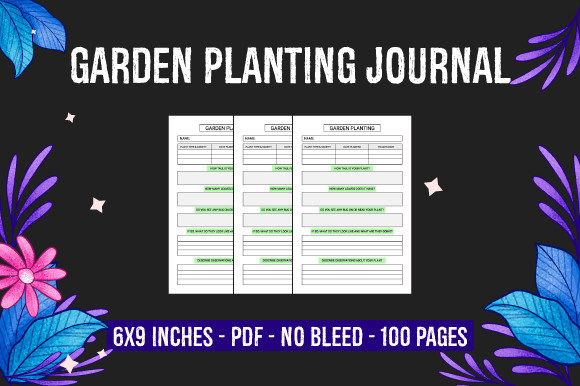
A Garden Planting Journal KDP Interior is a digital template, typically delivered as a high-resolution PDF, formatted specifically for print-on-demand production. The standard configuration for this asset includes a 6″ x 9″ trim size, which is widely considered the industry standard for portable field journals. The file contains 100 pages of structured content tailored to gardening activities rather than blank lines. This distinction categorizes the product as medium-content, implying a higher utility value than a generic notebook.
Technically, these files are designated as "No Bleed." This means all text, graphics, and tracking tables are contained within the safe zone margins, ensuring no critical information is trimmed during the printing process. The 100-page count is a strategic specification; it provides sufficient space for a full growing season of records while keeping the spine width substantial enough for legible text and maintaining competitive printing costs. When evaluating these interiors, one must verify that the resolution meets or exceeds 300 DPI to ensure crisp printing of fine lines and small text often found in planting calendars and seed inventory logs.
Strategic Advantages of Pre-Formatted Interiors
The primary driver for acquiring a ready-to-use Garden Planting Journal KDP Interior is time efficiency. Designing a functional gardening log requires research into hardiness zones, frost dates, plant spacing requirements, and harvest tracking metrics. A professionally structured interior consolidates this domain knowledge into a usable format, eliminating dozens of hours of layout work and botanical research. For publishers managing multiple SKUs across different niches, this acceleration allows for broader portfolio testing without significant upfront labor investment.
Furthermore, standardized dimensions and bleed settings reduce technical friction. Formatting errors are a common cause of KDP rejection or poor customer reviews. Using a verified 6″ x 9″ no-bleed template mitigates the risk of margin violations or gutter issues that frequently plague self-designed manuscripts. This reliability is particularly valuable for publishers who lack advanced proficiency in typesetting software like Adobe InDesign or Affinity Publisher. The consistency of a pre-made file ensures that the final physical product matches the digital proof, creating a predictable baseline for quality control.
Critical Tradeoffs and Market Considerations
While convenience is a significant benefit, reliance on a Garden Planting Journal KDP Interior introduces distinct tradeoffs. The most pressing concern is market differentiation. Because these files are sold to multiple users, identical interiors may exist across various listings on Amazon. If a publisher relies solely on the provided interior without modification, the resulting book becomes a commodity competing primarily on price and cover aesthetics. In a saturated niche, identical internal structures can lead to negative reviews if customers feel they have purchased a duplicate of another journal.
Another consideration is regional relevance. Gardening is inherently local. A generic interior may include frost date charts or planting schedules that apply to a broad average but fail to serve specific climate zones accurately. Publishers targeting a specific geographic demographic, such as Pacific Northwest gardeners or Florida homesteaders, may find a universal template insufficient. In such cases, the time saved on formatting might be negated by the need to extensively edit or supplement the pages to provide genuine local value. Evaluators must assess whether the included prompts and trackers are universally applicable or too generalized to be useful.
Ideal Use Cases for Pre-Made Templates
Despite the limitations, there are specific scenarios where a Garden Planting Journal KDP Interior is a strong strategic fit. New publishers entering the gardening niche often benefit from using these templates as a learning tool. By analyzing a professional layout, beginners can understand effective information architecture, appropriate font sizing for handwriting, and logical flow between seasonal planning and daily logging. This reverse-engineering process builds design competency faster than starting from scratch.
Additionally, these interiors are well-suited for bundling strategies. Rather than selling the journal as a standalone product, publishers can pair the standard interior with a highly specific, custom-designed cover and targeted metadata. If the cover clearly communicates a unique angle—such as "Organic Vegetable Tracking" or "Herb Garden Planner"—the standard interior serves as a reliable foundation while the exterior branding captures the specific audience. This approach leverages the speed of pre-made assets while maintaining the appearance of a bespoke product through external differentiation.
When to Pursue Custom Alternatives
There are definitive situations where alternatives to a ready-to-use PDF are preferable. Publishers aiming to build a recognizable brand identity should avoid unmodified templates. Brand loyalty in the low-content space is built on consistent user experience and proprietary layouts. If the goal is to create a series where customers return for subsequent volumes, a unique interior design is non-negotiable. Similarly, if market research reveals specific gaps in existing offerings—such as a lack of hydroponic tracking or permaculture mapping—a generic garden journal will not address those unmet needs.
Technical constraints also warrant custom solutions. If a publisher intends to use bleed elements, such as full-page botanical illustrations or edge-to-edge tab dividers, a standard no-bleed template is incompatible. Furthermore, authors with specialized expertise may find that pre-made trackers do not align with their specific methodologies. In these instances, hiring a freelance designer or investing time in custom creation yields a superior product that justifies a higher price point and reduces direct competition with other template users.
Decision Framework for Selection
Determining whether a Garden Planting Journal KDP Interior aligns with business goals requires a practical audit. Prospective users should first inspect sample pages to verify that the line weight is appropriate for pencil and pen use, and that the paper usage is efficient. Wasted whitespace reduces the perceived value of a 100-page book. Next, evaluate the licensing terms. Some providers restrict the number of times a file can be used or prohibit certain types of modifications. Ensuring commercial rights match the intended scale of distribution is a mandatory due diligence step.
Finally, conduct a competitive analysis before purchase. Search Amazon for keywords related to the template’s specific features. If dozens of books share the exact same interior page layouts, the barrier to entry for sales is significantly higher. Conversely, if the template offers unique features not commonly seen in top-selling journals, it may represent a viable opportunity. The decision should ultimately balance the immediate savings in production time against the long-term viability of the product in a competitive marketplace. A ready-to-use file is a tool, not a guarantee; its value is determined entirely by how strategically it is implemented within a broader publishing plan.