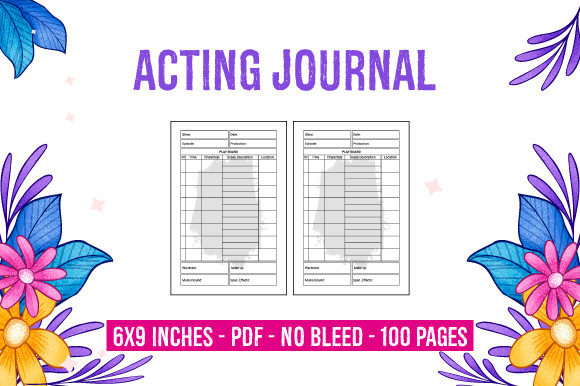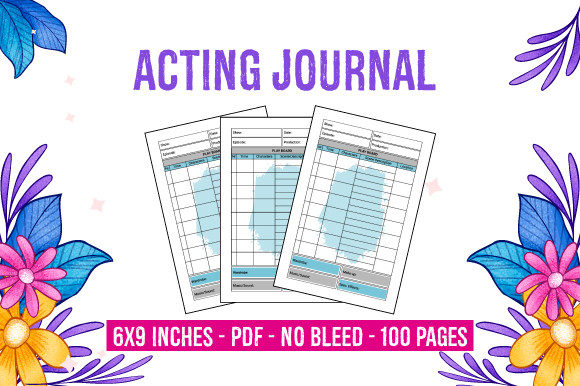
Acting Journal Interior: A Practical Guide for KDP and POD Publishers
The self-publishing landscape has evolved significantly, moving beyond simple lined notebooks to highly specialized tools that serve niche communities. Among these specialized resources, the Acting Journal Interior stands out as a vital asset for creators targeting performers, drama students, and theater professionals. For publishers utilizing Amazon Kindle Direct Publishing (KDP) or other Print on Demand (POD) platforms, understanding the specific utility and technical requirements of this interior is essential for creating a product that offers genuine value rather than just filling space on a digital shelf.
This guide explores the practical application, technical specifications, and strategic considerations for using a ready-to-use Acting Journal Interior PDF in your publishing business. Whether you are a seasoned KDP publisher or new to low-content books, recognizing the nuances of this specific niche will help you produce high-quality journals that resonate with the acting community.
Understanding the Purpose of an Acting Journal
To successfully market and utilize an Acting Journal Interior, one must first understand what actors actually do with these books. Unlike a standard diary, an acting journal is a functional workspace. It serves as a repository for character development, script analysis, rehearsal notes, and emotional recall exercises. When you provide a pre-formatted interior, you are essentially providing a structured methodology for the user’s creative process.
The primary users of these journals include:
- Method Actors: Who require dedicated space for sensory work and emotional memory tracking.
- Drama Students: Who need to document class exercises, monologue choices, and instructor feedback.
- Professional Theater Performers: Who use journals to track blocking, costume changes, and performance consistency over long runs.
- Film and TV Actors: Who often work out of sequence and need non-linear organization for scene breakdowns.
By offering a 100-page interior designed specifically for these tasks, you solve a problem for the consumer. They no longer have to draw tables or create headers from scratch; they can simply add a cover and publish a tool that is immediately useful.
Technical Specifications and File Standards
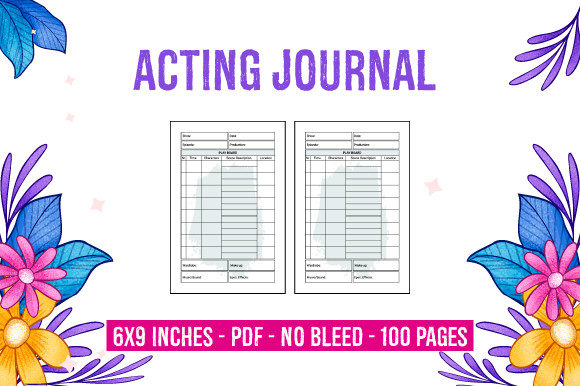
When working with ready-to-use PDF files for KDP, adherence to technical standards is non-negotiable. The specific Acting Journal Interior described here comes with precise parameters that ensure a smooth upload and printing process.
Dimensions and Trim Size
The standard dimension for this interior is 6″ x 9″ inches. This is widely considered the industry gold standard for trade paperbacks and journals in the performing arts niche. It strikes an ideal balance between portability and usability. An actor needs a journal that fits easily into a backpack, a large coat pocket, or a stage bag, yet provides enough surface area for writing detailed notes during rehearsals. Straying from this size can sometimes limit the perceived professionalism of the book or make it cumbersome for daily carry.
Page Count and Structure
The file includes 100 pages of formatted interiors. In the context of KDP, this page count is significant. It meets the minimum threshold for spine text eligibility on many POD platforms, allowing the book to look like a legitimate volume on a bookstore shelf. Furthermore, 100 pages provide substantial utility without driving the printing cost so high that the retail price becomes prohibitive. For a working actor, this length typically represents several months of active use or a complete production cycle.
Bleed vs. No Bleed Configuration
This specific interior is configured as No Bleed. Understanding this distinction is critical for avoiding rejection during the KDP proofing stage. "No Bleed" means that all text, lines, and graphics are contained within the safe margin zone, keeping them away from the trim edge. This is generally preferred for journals because it ensures that no part of the writing prompt or table structure is accidentally cut off during the binding and trimming process. When designing your cover to match this interior, ensure you select the "No Bleed" option in your cover calculator to maintain alignment.
Resolution and Print Quality
The files are provided as High-Resolution PDFs. Low-content books live and die by their print clarity. Blurry lines or pixelated text destroy credibility instantly. High-resolution vectors ensure that whether the customer orders a black-and-white standard copy or a premium color option, the lines remain crisp and the text remains legible. Always verify the DPI (dots per inch) of any third-party interior before uploading; 300 DPI is the recommended standard for professional results.
Evaluating Content Suitability and Layout
Not all acting journal interiors are created equal. Before adding a cover and publishing, evaluate the internal layout against real-world acting needs. A generic lined page is rarely sufficient for this audience. A high-value Acting Journal Interior should ideally feature a mix of the following elements:
- Character Profile Templates: Sections for physical traits, psychological motivations, backstory, and relationships.
- Script Analysis Grids: Space for breaking down beats, objectives, obstacles, and tactics within a scene.
- Rehearsal Logs: Daily trackers for what was worked on, breakthroughs achieved, and questions for the director.
- Voice and Movement Trackers: Areas to note vocal warm-ups, dialect coaching notes, or choreography counts.
- Audition Prep Sheets: Quick-reference layouts for casting details, monologue choices, and post-audition reflection.
If the ready-to-use PDF you are considering lacks these specific structural elements, it may be better suited as a general notebook rather than a specialized acting tool. Authenticity drives sales in niche markets; experienced actors can quickly identify whether a journal was designed by someone who understands their craft or merely assembled from generic templates.
Strategic Considerations for POD Publishers
While the convenience of a ready-to-use Acting Journal Interior accelerates the publishing timeline, successful integration requires strategic oversight. Simply uploading the file is only the first step.
Cover Design Alignment
Your cover must visually communicate the interior's purpose. Avoid generic floral patterns or abstract art unless they clearly signal "theater" or "performance." Typography should be readable at thumbnail size. Consider using imagery associated with the stage, scripts, spotlights, or classic theatrical masks. The cover sets the expectation for the structured content inside; a mismatch leads to returns and negative reviews.
Keyword Research and Metadata
Because this is a specialized product, broad keywords like "journal" or "notebook" will likely result in poor visibility. Focus on long-tail semantic phrases that actors actually search for. Examples might include "character development workbook," "actor rehearsal log," "drama student gift," or "Stanislavski method journal." Analyze competitor listings to understand which terms drive traffic, but always prioritize accuracy over keyword stuffing.
Licensing and Commercial Rights
Always verify the license agreement accompanying the ready-to-use PDF. Ensure you have full commercial rights to use the interior for KDP and POD. Some licenses restrict the number of publications, require attribution, or prohibit modification. Respecting intellectual property protects your business from takedowns and legal issues. If the license allows modification, consider adding unique introductory pages or branding to differentiate your edition from others using the same base file.
Real-World Applications and User Scenarios
To better understand the market potential, consider how this product functions in actual scenarios. A university drama professor might adopt a specific Acting Journal Interior as a required supplement for a semester-long acting technique class, ordering copies for twenty students. A community theater director might purchase them as gifts for the cast of a summer production to encourage disciplined preparation. An independent film actor might buy a fresh copy for every new project to maintain separation between roles.
These scenarios highlight that the buyer is not always the end-user. Parents, teachers, directors, and friends often purchase these journals as gifts. Your marketing copy and backend keywords should reflect both the practitioner and the gift-giver. Emphasize the educational and organizational benefits when targeting buyers who may not be actors themselves but want to support someone who is.
Limitations and Managing Expectations
While ready-to-use interiors offer efficiency, they come with inherent limitations. Because the file is pre-made, you cannot easily customize the prompts or layout without advanced design software and source files. If the acting community shifts toward a new methodology or terminology, a static PDF cannot adapt. Additionally, since multiple publishers may access the same ready-to-use files, differentiation becomes challenging. You must compensate for this through superior cover design, compelling book descriptions, and excellent customer engagement.
Publishers should also manage their own expectations regarding profitability. Niche journals typically sell in lower volumes than mass-market notebooks. However, they often command higher price points and foster greater brand loyalty. Success in this space is measured by building a catalog of trusted resources for a specific community, not by chasing viral bestseller status.
Making the Right Choice for Your Catalog
Incorporating an Acting Journal Interior into your KDP or POD portfolio is a strategic decision that balances efficiency with niche expertise. The 6″ x 9″, 100-page, no-bleed, high-resolution format provides a solid technical foundation compliant with Amazon’s standards. However, the true value lies in how well the content serves the actor’s creative process.
Before publishing, ask yourself: Does this interior genuinely help an actor prepare, perform, or reflect? Is my cover design authentic to the theater community? Have I optimized my metadata to reach both practitioners and gift-givers? By approaching this product with a service-oriented mindset rather than a purely transactional one, you contribute meaningfully to the artistic ecosystem while building a sustainable publishing business. The ready-to-use PDF is merely the starting point; your curation, presentation, and understanding of the audience determine the final quality and success of the publication.